
Selecting the correct Battery Management System (BMS) dictates the safety, efficiency, and lifecycle of energy storage systems (ESS) and electric vehicles (EV). Procurement managers and engineers must evaluate suppliers strictly on technical architecture, scalability, and manufacturing capabilities. This analysis outlines the top 10 BMS suppliers serving the US market, evaluating their core competencies, production capacity, and integration potential.
B2B Procurement Criteria for Battery Management Systems
Before auditing individual manufacturers, procurement teams must align their sourcing strategy with core technical and logistical parameters.
Quality Control (QC) & Regulatory Compliance
Certifications dictate market access. North American deployments require adherence to UL 1973 (stationary batteries) and UL 2580 (EV applications). European distribution requires CE marking. Strict QC protocols must encompass hardware-in-the-loop (HIL) testing, thermal runaway mitigation, and electromagnetic compatibility (EMC) validation to prevent field failures.
Lead Time & Supply Chain Stability
Semiconductor market fluctuations dictate production timelines. Procurement teams must prioritize suppliers utilizing vertically integrated manufacturing and diversified component sourcing. A stable supply chain maintains standard lead times within an 8 to 12-week window, preventing costly project delays.
Minimum Order Quantity (MOQ) & Customization (OEM/ODM)
Off-the-shelf BMS units accommodate prototyping, but scaling production requires OEM/ODM flexibility. Engineering teams must secure suppliers capable of modifying communication protocols (CAN, RS485), firmware logic, and current capacities without demanding prohibitive MOQs.
Top 10 BMS Manufacturers Serving the US Market (2026 Ranking)
The following manufacturers lead the US market in hardware reliability, component availability, and engineering support.
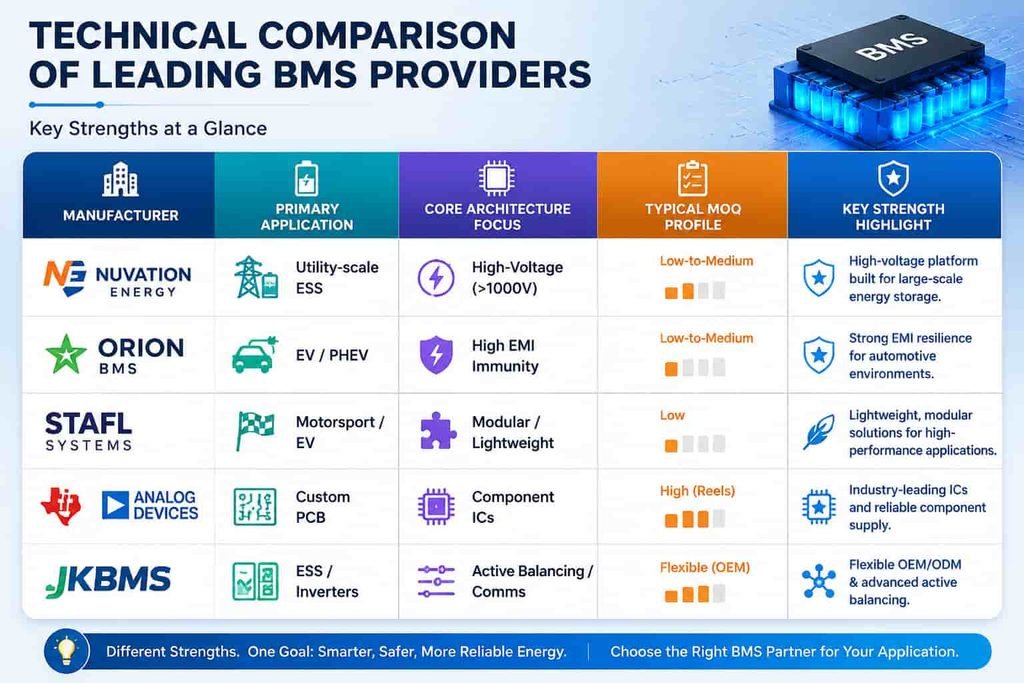
1. Nuvation Energy
- Use Case: Utility-scale ESS and commercial energy storage.
- Pros: High-voltage architecture (up to 1250V), stringent UL 1973 safety certification.
- Cons: High cost per unit; complex integration matrix for small-scale, low-voltage systems.
2. Orion BMS (Ewert Energy Systems)
- Use Case: Electric vehicles, hybrid automotive platforms, and commercial EVs.
- Pros: High EMI immunity, extensive programmable parameters, redundant design architecture.
- Cons: Less economically competitive for stationary residential energy storage applications.
3. Sensata Technologies (Lithium Balance)
- Use Case: Industrial automation, heavy-duty electric mobility, and grid storage.
- Pros: Enterprise-grade supply chain stability, ISO 26262 compliance, robust thermal management.
- Cons: Strict target market focus; typically requires high volume commitments.
4. STAFL Systems
- Use Case: Electric motorsport and advanced EV platforms.
- Pros: Modular BMS1000 Series architecture, rapid prototyping support, lightweight components.
- Cons: Niche market focus limits off-the-shelf availability for large-scale stationary ESS.
5. Texas Instruments (TI)
- Use Case: Custom PCB designs requiring integrated circuit (IC) level BMS monitoring.
- Pros: Industry-leading component precision, vast technical documentation, massive scale.
- Cons: Requires complete in-house engineering, firmware development, and PCB manufacturing.
6. Analog Devices, Inc. (ADI)
- Use Case: High-accuracy cell monitoring for grid-scale batteries.
- Pros: Exceptional voltage measurement accuracy, ISO 26262 compliant components.
- Cons: Component-level supplier only; does not provide plug-and-play complete BMS enclosures.
7. NXP Semiconductors
- Use Case: Automotive-grade battery controllers and microcontrollers.
- Pros: Advanced ASIL D functional safety compliance, integrated automotive networks.
- Cons: Target audience limited primarily to Tier 1 automotive suppliers.
8. Renesas Electronics
- Use Case: E-mobility and industrial power tools.
- Pros: High integration of microcontrollers and analog front-ends, long lifecycle support.
- Cons: Software development kit (SDK) presents a steep learning curve for lean engineering teams.
9. AVL
- Use Case: Automotive prototype testing and specialized vehicle applications.
- Pros: Comprehensive Hardware-in-the-loop (HiL) testing solutions, modular control systems.
- Cons: Focuses heavily on testing/R&D platforms rather than pure high-volume BMS manufacturing.
10. JKBMS (Featured Top-Tier Alternative)
- Use Case: Scalable ESS, residential solar inverters, and high-cycle life industrial applications.
- Pros: Direct-factory pricing, advanced active balancing technology, robust inverter compatibility.
- Cons: Primarily targets pack builders and OEM/ODM rather than component-level IC buyers.
Deep Technical Analysis: The JKBMS Advantage
For global distributors and engineers seeking high-performance hardware without enterprise-level MOQs, JKBMS engineers systems optimized for longevity and interoperability. Rather than acting strictly as an IC vendor, JKBMS delivers complete, deployable modules designed for immediate integration.
Core Technical Specifications
Active Balancing vs. Passive Balancing
Passive balancing bleeds excess energy from high-capacity cells as heat, wasting power and increasing thermal load. JKBMS utilizes 0.4A-2A Active Balancing technology. This system actively redistributes energy from higher-voltage cells to lower-voltage cells. This process maximizes the usable capacity of the pack, prevents premature voltage cutoff, and substantially increases the overall cycle life of the battery.
Hardware and Software Integration
- Broad Inverter Compatibility: Built-in CAN bus and RS485 communication protocols guarantee seamless handshakes with leading inverter brands, including Victron, Deye, and Growatt.
- Scalable Architecture: Highly customizable configurations ranging from 8S to 32S, supporting varying voltage requirements for both LiFePO4 and standard Li-ion chemistries.
- Environmental Resilience: Features a low-temperature heating function, ensuring safe charging parameters in freezing climates and preventing lithium plating during sub-zero charging cycles.
- Telemetry & Control: Equipped with a built-in smart Bluetooth App for real-time remote monitoring, granular parameter adjustment, and predictive diagnostics.
Frequently Asked Questions (FAQ)
What certifications are critical when sourcing a BMS in the USA?
B2B buyers should require UL 1973, UL 2580, CE, and RoHS certifications to ensure safety, electromagnetic compatibility, and compliance with North American grid and automotive standards.
How does active balancing impact lithium-ion battery lifecycle?
Active balancing redistributes energy from higher-voltage cells to lower-voltage cells (typically between 0.4A and 2A). This prevents overcharging, maximizes usable capacity, and significantly extends the overall cycle life of the battery pack compared to passive balancing.
What are typical MOQs and lead times for custom OEM/ODM BMS production?
Standard off-the-shelf units may have no MOQ, but custom OEM/ODM projects typically require MOQs ranging from 500 to 5,000 units. Lead times for custom configurations average 8 to 12 weeks, depending on component availability and supply chain stability.
Ready to scale your energy storage production?
Contact our engineering team to request a quote, secure wholesale pricing, and download the full technical spec sheet for your custom OEM/ODM project.
Need a Reliable BMS Solution for Your Project?
JKBMS offers industry-leading active balancing battery management systems. Contact our engineering team today for technical support and customized quotes.
Consult an Expert Now