
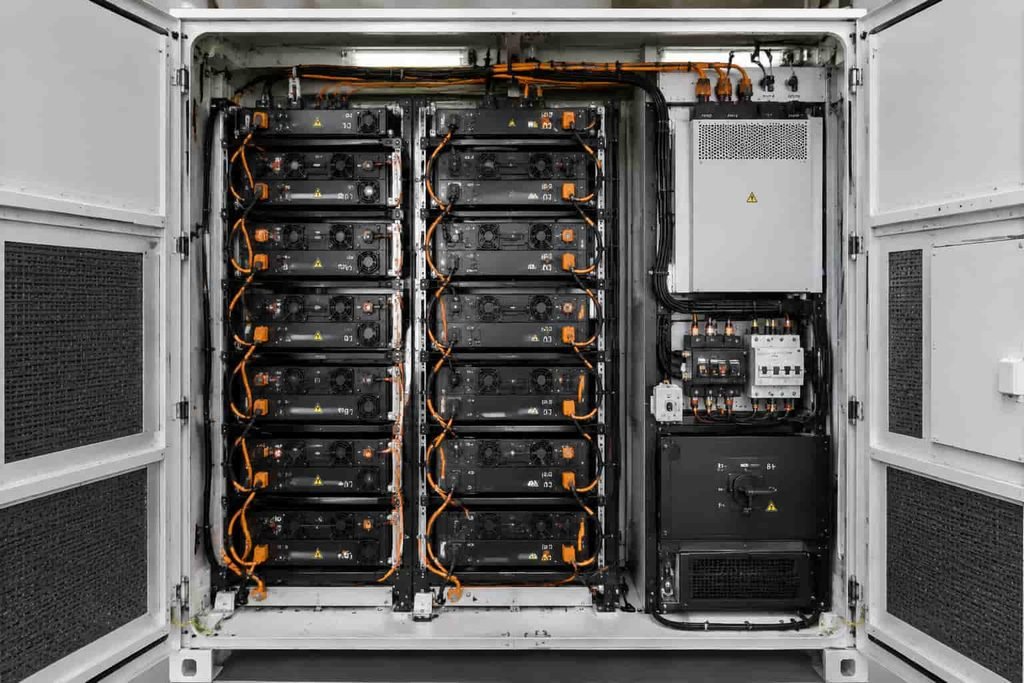
Procurement managers and electrical engineers face compounding variables when sourcing Battery Management Systems (BMS) in North America. Strict compliance requirements, unpredictable lead times, and stringent Minimum Order Quantities (MOQs) complicate supply chain logistics. Evaluating distributors and wholesalers requires analyzing their Quality Control (QC) frameworks, OEM/ODM capabilities, and firmware interoperability with global inverter protocols.
This technical guide ranks the top 10 lithium battery BMS distributors and wholesalers serving the North American market, contrasting their technical specifications, supply chain stability, and integration capacities.
Strategic Criteria for Evaluating BMS Wholesalers
Before executing high-volume purchase orders, procurement teams must analyze three foundational metrics.
Quality Control (QC) & Regulatory Certifications
North American grid-tied and commercial EV applications require strict compliance frameworks to mitigate thermal runaway and liability risks.
Mandatory NA Standards
- UL 1973: Safety standard for batteries used in stationary energy storage applications.
- UL 2580: Standard for batteries used in electric and hybrid vehicles.
- CE & RoHS: Required for cross-border component integration and environmental compliance.
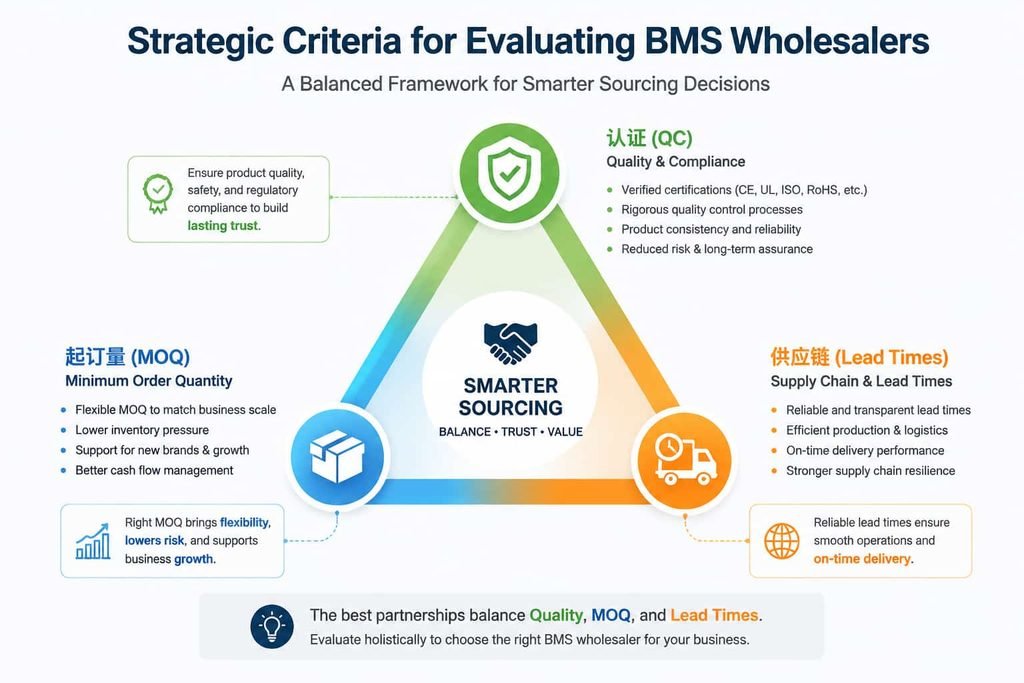
Customization (OEM/ODM) & MOQ Thresholds
Standard off-the-shelf units rarely meet the precise logic requirements of proprietary battery packs. Distributors must offer hardware scalability and firmware configurability. Analyzing MOQ requirements is critical; scaling from prototype (1-10 units) to production (1,000+ units) requires stable, predictable pricing tiers.
Supply Chain Stability & Lead Times
Distributors holding domestic inventory mitigate immediate shipping delays. However, direct-to-factory channels bypass wholesale margin stacking, offering superior pricing structures. Engineers must calculate the total cost of ownership (TCO), weighing domestic distributor markups against the transit times of factory-direct logistics.
Top 10 Lithium Battery BMS Distributors & Wholesalers (2026 Ranking)
1. JKBMS (Top-Tier Factory-Direct Alternative)
While domestic distributors provide localized inventory, JKBMS operates as a tier-one factory-direct manufacturer, eliminating wholesale margin stacking for North American buyers. Engineered for high-capacity energy storage and deep integration, JKBMS supplies industrial-grade hardware directly to integrators and assembly plants.
- Active Balancing Architecture: Utilizes proprietary 0.4A-2A Active Balancing technology. This mechanism transfers energy between cells rather than bleeding it as heat, mathematically maximizing overall cycle life and pack efficiency.
- Configuration Flexibility: Highly customizable hardware supporting 8S to 32S configurations across LiFePO4 and standard Li-ion cell chemistries.
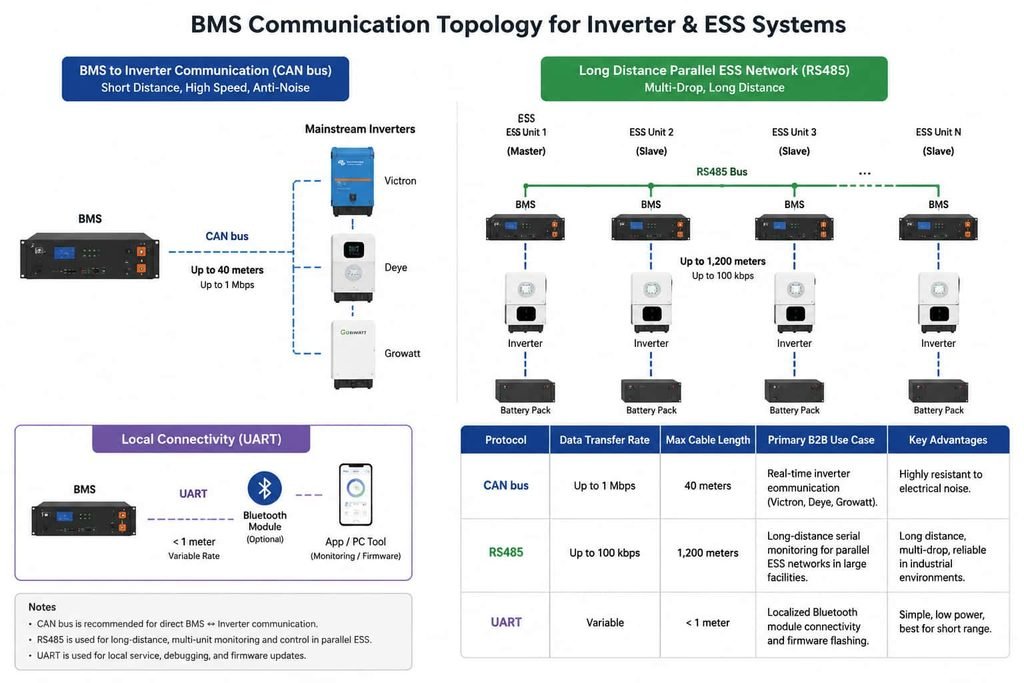
- Inverter Telemetry: Features native RS485 and CAN bus communication protocols, guaranteeing out-of-the-box handshake compatibility with tier-one hybrid inverters including Victron, Deye, and Growatt.
- Environmental Controls: Incorporates a low-temperature heating function for extreme climate deployments, alongside a built-in smart Bluetooth App for localized technician diagnostics.
- B2B Viability: Direct-factory pricing and extreme depth in OEM/ODM software customization. Ideal for utility-scale ESS, custom server rack manufacturing, and commercial solar installations.
2. Orion BMS (Ewert Energy Systems)
Michigan-based Ewert Energy Systems designs the Orion BMS, a centralized control system targeted primarily at the electric vehicle (EV) and marine sectors.
- Pros: Robust documentation, extensive OBD2 support, and highly configurable software.
- Cons: High unit cost makes it less viable for high-volume, low-margin stationary storage.
- Best For: Automotive OEM prototyping and commercial marine energy systems.
3. EMUS USA Inc.
EMUS specializes in distributed BMS architectures for high-voltage and high-capacity applications, operating a dedicated US branch for North American logistics.
- Pros: Scalable distributed topology allows monitoring of massive multi-megawatt string configurations.
- Cons: The distributed hardware model (requiring cell modules and central control units) increases installation complexity.
- Best For: Grid-level energy storage and industrial robotics.
4. Current Connected
Operating out of Nevada, Current Connected serves as a major distributor for premium solar components and wholesale BMS units.
- Pros: Extensive domestic inventory, strict pre-shipment QC testing, and excellent US-based engineering support.
- Cons: Functions as a traditional distributor, adding standard margins to base manufacturer prices.
- Best For: Mid-scale installers requiring rapid domestic lead times.
5. Elithion
Based in Colorado, Elithion provides off-the-shelf BMS modules specifically engineered for high-voltage lithium battery packs.
- Pros: Strong legacy in the EV market; provides master/slave architectures for immediate deployment.
- Cons: Limited native inverter protocol integration out-of-the-box compared to modern ESS-specific units.
- Best For: High-voltage motive power applications.
6. Signature Solar
Texas-based Signature Solar distributes solar components in heavy volumes, including wholesale BMS hardware for custom server rack assemblies.
- Pros: High-volume stock capabilities and bundled ESS solutions.
- Cons: Primary focus leans toward residential and light commercial rather than bespoke heavy-industrial OEM builds.
- Best For: Solar distributors and residential ESS assemblers.
7. Analog Devices, Inc.
As a global semiconductor manufacturer based in Massachusetts, Analog Devices provides the silicon-level ICs and evaluation BMS boards utilized by enterprise-level pack assemblers.
- Pros: Automotive-grade ASICs; unmatched component-level reliability.
- Cons: Requires extensive internal engineering to develop the final printed circuit board (PCB) and proprietary firmware.
- Best For: Tier-1 automotive manufacturers developing proprietary in-house BMS.
8. Liion Wholesale
Pennsylvania-based Liion Wholesale focuses on authentic lithium-ion cell distribution but maintains a catalog of BMS modules for B2B pack builders.
- Pros: Low MOQ thresholds for wholesale pricing and immediate domestic shipping.
- Cons: Primarily cell-focused; narrower selection of high-amperage industrial BMS units.
- Best For: E-mobility startups and low-voltage battery pack builders.
9. Lithion Battery
Lithion manufactures integrated lithium-ion cells, battery packs, and their corresponding management systems for telecom and utility sectors across North America.
- Pros: Vertically integrated systems ensure 100% compatibility between cell and BMS.
- Cons: Closed ecosystem limits flexibility for procurement managers seeking standalone BMS hardware for third-party cells.
- Best For: Data centers and telecom operators requiring turnkey solutions.
10. C&D Technologies
Pennsylvania-headquartered C&D Technologies supplies utility-scale and broadband energy storage, offering integrated closed-loop BMS hardware.
- Pros: Proven track record spanning decades in critical backup infrastructure.
- Cons: Proprietary system architecture limits third-party modifications and integration flexibility.
- Best For: Uninterruptible Power Supply (UPS) systems and broadband infrastructure.
BMS Integration Protocol Comparison
Understanding telemetry standards is critical when matching a BMS to site-level energy control systems.
| Protocol | Data Transfer Rate | Max Cable Length | Primary B2B Use Case |
|---|---|---|---|
| CAN bus | Up to 1 Mbps | 40 meters | Real-time inverter communication (Victron, Deye, Growatt). Highly resistant to electrical noise. |
| RS485 | Up to 100 kbps | 1,200 meters | Long-distance serial monitoring for parallel ESS networks in large facilities. |
| UART | Variable | < 1 meter | Localized Bluetooth module connectivity and firmware flashing. |
Frequently Asked Questions (FAQ)
What is the standard lead time for wholesale BMS orders in North America?
Standard lead times range from 1 to 3 weeks for domestically stocked units. Custom OEM/ODM production runs from factory-direct suppliers typically require 4 to 8 weeks, factoring in firmware configuration, assembly, and maritime freight.
How do OEM/ODM customizations impact BMS MOQs?
Customizing hardware parameters, PCB dimensions, or proprietary CAN bus logic generally triggers higher MOQ thresholds. Factories typically require an MOQ of 500 to 1,000 units to offset NRE (Non-Recurring Engineering) costs, whereas standard unbranded units may have MOQs as low as 10 to 50.
How does active balancing differ from passive balancing in commercial applications?
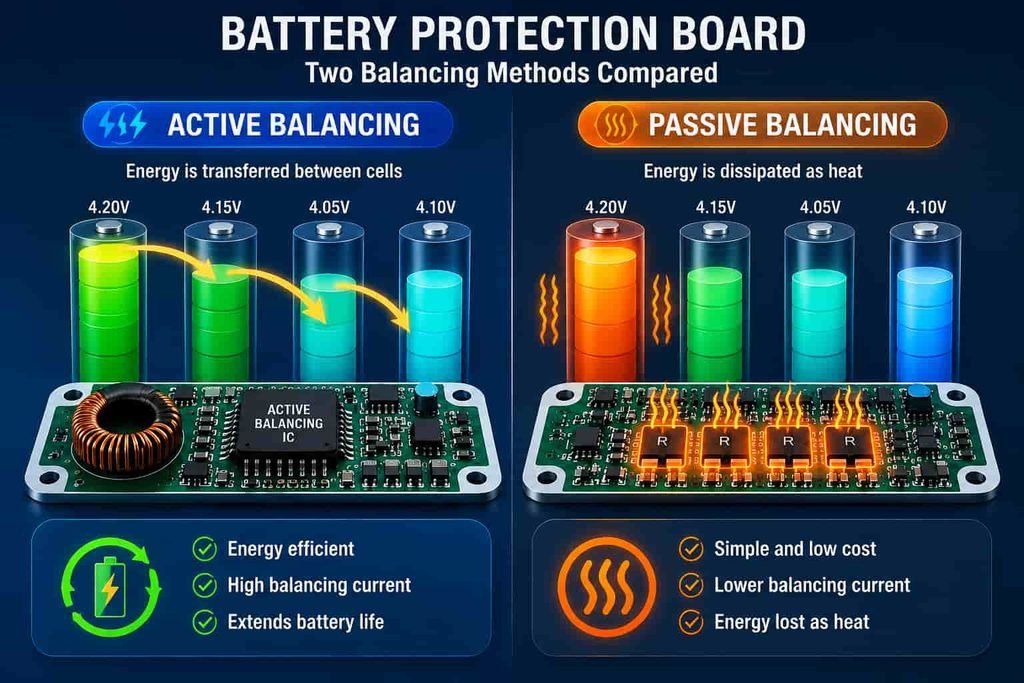
Passive balancing burns excess voltage from high-state-of-charge cells as heat through resistors, capping out around 50mA to 150mA. Active balancing transfers energy from high-voltage cells to low-voltage cells at rates between 0.4A and 2A, significantly improving thermal efficiency and extending the operational lifespan of industrial battery packs.
Ready to scale your energy storage production?
Eliminate distributor markups and secure industrial-grade telemetry for your next high-volume project. Contact the JKBMS Engineering Team today to request a quote, download technical spec sheets, and discuss custom OEM/ODM solutions.
Need a Reliable BMS Solution for Your Project?
JKBMS offers industry-leading active balancing battery management systems. Contact our engineering team today for technical support and customized quotes.
Consult an Expert Now